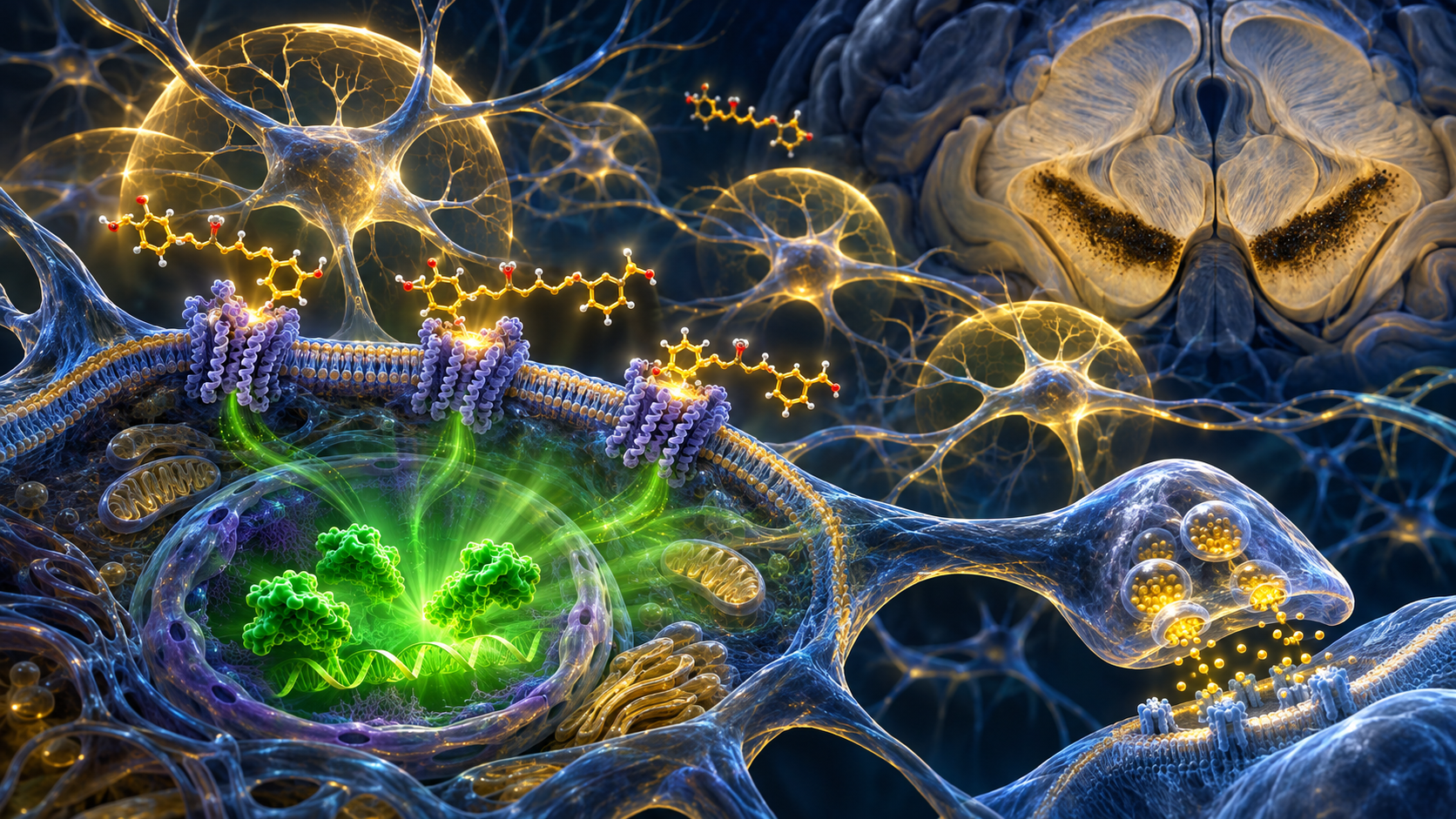
Introduction: Why This Matters
Parkinson’s disease (PD) is a debilitating neurodegenerative disorder characterized by progressive loss of motor control and cognitive decline. Current treatments like L-DOPA offer only symptomatic relief and often bring severe side effects, leaving a critical need for therapies that modify disease progression.
Oxidative stress plays a major role in PD pathology, damaging neurons through excessive free radicals. The cellular defense system, regulated in part by NRF2, a master antioxidant transcription factor, is crucial for combating this stress. Enhancing NRF2 activity and targeting key proteins involved in PD could pave the way for novel, effective treatments.
Study Overview: What Researchers Did
This groundbreaking study integrated advanced computational techniques to identify natural compounds that inhibit proteins linked to PD, including the adenosine A₂A receptor (A₂AR), GABA-A receptor, NRF2, and α-synuclein.
The researchers developed a multi-stage computational pipeline combining:
- Graph Attention Networks (GATs) for superior quantitative structure-activity relationship (QSAR) modeling
- Molecular docking to predict binding affinities
- Density Functional Theory (DFT) to analyze chemical reactivity
- Molecular Dynamics (MD) simulations to assess binding stability
- ADMET profiling to evaluate drug-likeness and safety
A large dataset of 1,393 structurally diverse compounds was used to train and validate predictive models, ensuring robustness and reducing overfitting.
Key Findings: The Results
- Graph Attention Networks (GATs) outperformed traditional algorithms with an impressive R2 of 0.991 and Q2 of 0.987, highlighting their predictive power for QSAR modeling.
- Bisdemethoxycurcumin (BDMC), a phytochemical from Curcuma longa, showed the strongest binding affinity to the A₂A receptor at -9.1 kcal/mol, surpassing L-DOPA’s weaker affinity (-7.2 kcal/mol).
- DFT calculations revealed BDMC’s low HOMO-LUMO energy gap (0.1428 eV) and high electrophilicity index (ω = 0.1477), indicating excellent chemical reactivity and electron-accepting ability.
- MD simulations confirmed stable BDMC-A₂A receptor interactions over 200 ns, with persistent hydrogen bonds and no dissociation events, suggesting strong and durable binding.
- The integrated approach also targeted NRF2, a key regulator of antioxidant responses, emphasizing the compound’s potential to enhance cellular defense against oxidative stress.
What This Means for You: Practical Takeaways
This study highlights bisdemethoxycurcumin as a promising natural compound that could lead to new, disease-modifying therapies for Parkinson’s disease. Unlike L-DOPA, which mainly replenishes dopamine and provides symptomatic relief, BDMC targets the A₂A receptor and may modulate pathways involved in neuroprotection.
Key practical insights include:
- Natural compounds like BDMC can serve as potent inhibitors of PD-related proteins, offering safer alternatives to synthetic drugs.
- Boosting NRF2 activity through such compounds may enhance the brain’s antioxidant defenses, reducing oxidative stress and potentially slowing PD progression.
- Advanced computational methods accelerate drug discovery by accurately predicting molecular interactions and stability, speeding up the identification of effective candidates.
For patients and researchers alike, these findings open exciting avenues toward therapies that not only alleviate symptoms but also protect neurons at the cellular level.
Conclusion
This innovative study demonstrates the power of integrating graph attention networks and deep learning with multi-stage computational screening to uncover natural compounds with therapeutic potential for Parkinson’s disease.
Bisdemethoxycurcumin stands out as a potent A₂A receptor inhibitor with strong binding affinity, chemical reactivity, and stable interactions, coupled with the ability to enhance NRF2-mediated antioxidant defense. These properties make it a compelling candidate for further experimental validation and drug development.
As research advances, leveraging natural antioxidants and cellular defense modulators like BDMC could revolutionize PD treatment, moving beyond symptomatic management to true disease modification.
References
For more detailed information, read the original study published in Bioorganic Chemistry by Khaled et al.: PMID: 42893649